The Rat Fan Club
This article is from the Rat Health Care booklet. Order one today! Check out the info at Rat Books
Tumors
by Debbie “The Rat Lady” Ducommun
updated
Along with respiratory infections, tumors are
one of the most common health problems and causes of death in rats, especially
in females. There are two main
types of tumors, benign and malignant. Benign tumors
are almost always encapsulated in a membrane and separate from nearby
tissues. Although they can grow as
fast as malignant tumors, they don’t usually
cause as much damage and they don’t metastasize (spread to other parts of
the body). Benign tumors can cause death by pressing on vital organs,
bleeding internally, or by growing so large that the rat has difficulty moving
around and can’t eat enough to support both the tumor
and normal body functions.
In contrast, malignant tumors, also called
cancer, usually invade and damage nearby tissues. They sometimes also metastasize (rarely
in rats). Death can be caused by
failure of damaged organs or mechanical interference with normal functions,
such as eating. The symptoms of
cancer can include a skin ulcer, infected lump, or abscess that won’t
heal, an ulcerated or bleeding tumor, a distended
abdomen, weight loss, and lethargy.
In some cases, cancer involves the internal organs, so symptoms often
aren’t seen until the disease is well advanced and euthanasia is the only
alternative. This is why it’s
important to give your rats a weekly exam.
Many benign tumors can be removed, depending
on the location, but I do not recommend surgery for most cancerous tumors. In many cases it results in an open wound that
won’t heal, and causes the tumor to grow back
more quickly. Some tumors can be temporarily shrunk with prednisone.
Mammary Tumors
The most common tumor in female rats is the benign
mammary tumor, most being a fibroadenoma
(fibro—from connective tissue,
Mammary tumors often start out squishy and
flat, and then become more firm, but they can also be quite hard from the
start. Because the tumors grow so quickly, a portion will sometimes outgrow
its blood supply, die and become necrotic and filled with pus. Mammary tumors also commonly contain pockets of milk, which can
grow very quickly.
Benign mammary tumors are usually distinct
lumps just under the skin that are only loosely attached. When you feel the lump, you can usually
move it separately from the skin and underlying muscle. If your rat gets one of
these tumors, you can be 99.9% sure it’s
benign. If a tumor
feels tightly attached to the underlying tissue, this can be a sign that it is
malignant, but I have found that some benign tumors
also feel attached because they are underneath connective tissue and
turn out to be easily removed by surgery. The best time to remove a benign
mammary tumor is when it is about the size of a large
marble. Benign mammary tumors can grow huge (up to
4" across). They tend to have a basically round shape that tends to
protrude. A malignant mammary tumor will rarely get
more than 2" across and tends to stay more flat.
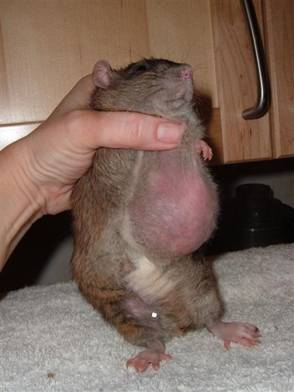
Here is Pumkin with a large benign mammary tumor. By her
back leg, you can see a staple from a previous tumor
removal surgery.

This rat has a medium-sized benign mammary tumor
in her groin.

This rat has a medium-sized mammary tumor
under her left arm.
For pictures of surgically removed mammary tumors,
click here.
In my experience, malignant mammary tumors
most commonly appear in the vulva/anus area, but not all tumors
in this area are malignant. The location alone is not enough for
diagnosis. Malignant mammary tumors can also appear under the arm. A mammary tumor that appears dark is almost sure to be
malignant. Malignant mammary tumors also commonly develop ulcers, abscesses and open
sores that weep bloody fluid and tissue. A benign mammary tumor
won’t develop an ulcer until it is huge. A needle biopsy is not
usually helpful in the diagnosis of the type of tumor.
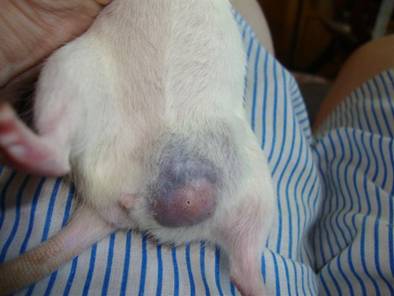
The blue color of this mass indicates it is a
malignant mammary tumor.
Surgery is not recommended for malignant mammary tumors, as they quickly grow back, but they can be successfully treated with tamoxifen. See the article Tamoxifen to Prevent and Treat Tumors.
Tamoxifen does not seem to be an effective treatment for benign mammary tumors. They must be surgically removed. If you decide not to have a benign mammary tumor removed, you can expect it to keep growing, until it is as big as the rat herself. Within a few months you must be prepared to have your rat euthanized when she is no longer enjoying life. In the meantime, you can help your rat maintain her quality of life by making sure she eats a very nutritious diet, high in protein, fat, and vitamins, because the tumor will be drawing resources and energy from her body.
A more rare cause of a lump near a nipple is a blocked milk duct or inflamed mammary gland. Treatment with warm compresses 2-3 times a day and an antibiotic should resolve this within a week.
Male rats can also get mammary tumors, but they are uncommon and almost always benign.
Lumps on the Throat
A lump on the throat can be an abscess, an inflamed salivary gland, a swollen lymph node, or a tumor.
Salivary glands can enlarge as an inflammatory response to the SDA virus or a bacterial infection. A lymph node can enlarge in response to a bacterial infection or cancer. These structures are paired on either side of the throat.
A gland or lymph node can swell up overnight, and an abscess can also appear quickly. Tumors tend to grow more slowly. For a sudden lump, try an anti-inflammatory first as this will usually cause a swollen gland or lymph node to shrink within 12-24 hours. You can also wait to see if it is an abscess (See Abscesses and Cysts, next article). See Abscesses.
Pituitary Tumors
The second most common type of tumor in female rats is an adenoma (benign tumor) of the pituitary gland, which lies beneath the brain. In fact, this is probably the third most common cause of death in female rats. The incidence in my unspayed female rats has been 20% and in my male rats 7%. Scientific studies show that having rats spayed reduces the chance of a pituitary tumor down to 4%. For photos of rat pituitary tumors, click here. (warning, very graphic)
A pituitary tumor is not as obvious as a mammary tumor as it grows inside the skull. As the tumor grows it presses on the brain and eventually causes neurological impairment. Symptoms may appear slowly, over a period of a few days or a few weeks, or quickly. These tumors are highly vascular and in some cases they can hemorrhage, which can cause acute severe symptoms, such as paralysis, seizures and death. It also seems that a slight hemorrhage from the tumor can cause symptoms that later clear up.
Typically, a pituitary tumor causes a gradual onset of symptoms, first poor coordination, then some loss of function of the arms, legs and mouth. They can usually still walk okay, but can have trouble eating. They can tend to hold their arms out stiffly with the hands curled. They can look unkempt, and porphyrin can be caked on the wrists. They can have strange behavior, act confused, be hyperactive, run into objects, or walk in circles. Some rats become infant-like and cuddly and must be hand-fed. Most rats with a pituitary tumor eventually can no longer swallow and will need to be euthanized at that point.
A rare symptom is bulging eyes through stimulation of the thyroid gland. These symptoms are sometimes mistaken for an inner ear infection, but that usually causes only a loss of balance, not poor coordination.
A symptom that is common and unique for a pituitary tumor is an inability to bend the arms, so the rat can’t hold food to her mouth. To test for this symptom, hold your rat in a sitting up position and offer her a favorite treat. If she can’t hold the food to her mouth, she definitely has a pituitary tumor.
The best treatment is cabergoline, which is specifically for pituitary tumors. It can be used along with the amoxicilin and prednisone. A case study published in the September 1, 2011 issue of the JVMA reported that a male rat with a large pituitary tumor was given about 8 more good months of life when treated with cabergoline. The dose given was 0.27 mg/lb once every 3 days. For a summary of this case, click here. I also know of several other cases where it has worked really well for 8-12 months. It can also start working the same day you start it!
Cabergoline is fairly expensive but you only need to give it every three days. You'll need to ask your vet to call in a prescription to a human pharmacy. The dose is 0.27 mg/lb every 3 days. The amount you need to buy to treat a 1-pound rat for a month is 2.7 mg. The largest size tablet that is available is 0.5 mg, so the dose is 1/2 tablet for a 1-lb rat. You will need 5 tablets to treat a 1-lb rat for a month. Cabergoline tastes bad, so you will need to force the dose. Cut a tablet in half and put it in a tiny measuring spoon. Drip 0.1 ml of flavoring on the tablet and let it soften. Then suck it up into a 1 ml syringe. Then you will need to squirt it in the back of your rat’s throat.
Other Common Tumors
Another fairly common tumor in rats is a fibroma. Because these tumors derive from fibrous tissue they are usually quite hard, but they are benign and easily removed. They are most common on the side or back.
One of the most common types of cancer in rats is squamous cell carcinoma. I’ve seen 6 of them, 2 on the face, one from the eyelid, and 3 under the jaw, and I’ve heard of several more. This type of tumor is most common on the face and should be suspected with any swelling or abscess in this area.
Another very common place for cancers to appear is directly below the ear. These cancers usually seem to be an abscess, and you should suspect any abscess in or around the ear of being cancer. These cancers can arise from the Zymbal’s gland, but in one of my rats, pathology found that such a tumor was a skin tumor. You’ll know that it is cancer if the abscess contains tiny lumps of white tissue or a soft mass of fibrous tissue instead of pus. These cancers also often bleed severely.
I know of several cases of fibrosarcoma. These commonly occur on the leg, but can also occur on the side. They tend to grow extremely fast. Surgery can’t cure them, but in some cases, “debulking” the tumor will give the rat more time, making this one of the only types of cancer that surgery can benefit.
I know of several cases of benign tumors growing in the vagina. When the tumor gets too large to remain inside the small vagina, it will protrude out. At first appearance a vaginal tumor can be mistaken for a prolapsed vagina, but a prolapse looks like a tube. It seems that for a vaginal tumor to be successfully removed, that portion of the vagina itself must be removed. This is possible in the rat, unlike dogs or cats, as the vagina is completely separate from the urethra.
To see photos of examples of these tumors, click here.
Less Common Tumors
I’ve known of two cases of histiocytic sarcoma. This is a cancer of the immune system, and in my rat there was no tumor in evidence, only abscesses resulting from the depressed immune system. I’ve known of 5 cases of lymphosarcoma in the chest, 2 in the abdomen, and one in the skin. I know of 3 cases of leukemia.
I know of one case of malignant melanoma on the scrotum, one case of a liposarcoma in the vagina, which was unfortunately also attached to the bladder, and 2 cases of bladder cancer.
I had a semi-hairless rat who grew numerous sebaceous epitheliomas during his life, and died at the age 2 years from a basal cell carcinoma with sebaceous and epithelial differentiation.
Tumor Surgery
Since 1985 I have done more than 1000 surgeries to remove tumors from rats, and only a few turned out to be malignant. I have removed tumors from only a few males; the vast majority were females, almost all of them with benign mammary tumors. I have good success removing this type of tumor.
Benign mammary tumors can be removed by minor surgery. The smaller the tumor, the more easily it can be removed (although I do not recommend doing anything for a lump the size of a pea as it could be just a cyst). But even huge tumors can be removed as long as your rat is otherwise in good health and steps are taken to prevent shock. I successfully removed a mammary tumor that weighed 340g from a rat that only weighed 244g!
I’ve removed many tumors from rats well over two years old, so age should not be the only factor when considering surgery. Because mammary tumors and fibromas are just under the skin, the surgery to remove them is minor, as opposed to major surgery which enters a body cavity, and rats usually recover quite quickly. In fact, even rats with congestive heart failure appear to tolerate surgery well if their symptoms are controlled with medications.
If a rat younger than 24 months has a mammary tumor removed, consider having her spayed at the same time to help prevent future mammary and pituitary tumors.
The cost for rat surgery has gone up alarmingly in recent years. In Chico (a town of 100,000) the charge is $200-300 depending on the size of the tumor. The fee is usually higher in larger cities. The cost for a spay usually ranges between $100-150. It’s usually cheaper and easier on your rat in the long run to have her spayed when she is young. (See Preventing Tumors below.)
Surgery can be beneficial for a fibrosarcoma. I know of 4 cases where having the tumor debulked gave the rat up to 8 more months of comfortable life. However, surgery on most cancers just results in a nasty wound that won’t heal and causes the cancer to grow back more quickly.
Tamoxifen Treatment
Tamoxifen, which blocks estrogen receptor sites in tissue, is a highly effective treatment for cancerous mammary tumors in rats. It is not a cure, but can retard the tumor for many months. I know of 7 cases where it was highly effective and gave the rat up to a year of quality life. However, tamoxifen does not seem to be an effective treatment for benign mammary tumors.
A safety study showed that tamoxifen is a safe treatment in adult female rats. It only caused problems when given to the rat for its whole life starting at 8-12 weeks of age. This study, Results of Three Life-Span Experimental Carcinogenicity and Anticarcinogenicity Studies on Tamoxifen in Rats, C. Maltoni et al, 1997, Ann. NY Acad Sci, 837, 469-512). To see the published conclusions and summary of this study, click here. To see the abstracts of 4 studies that show the positive effect of tamoxifen on mammary cancer, click here.
Tamoxifen is readily available from human pharmacies in the U.S. and veterinarians can call in a prescription. The dose is 3 mg/lb once a day for treatment of mamary cancer, and 1.5 mg/lb once a day for prevention. Ideally it should be given for the rest of the rat’s life. However, while most rats don’t object to the taste of tamoxifen at first, I know several cases where rats given tamoxifen have developed a strong reluctance to take the oral medication after a few weeks. This can make it difficult to carry out long-term treatment. I successfully treated one of my rats for almost a year, one month on and one month off. Even short-term treatment can help retard the growth of cancerous mammary tumors.
You may not see any shrinkage of the tumor for 2-3 weeks, so don’t give up too soon; measure and record the size of the tumor at the start of treatment so you can keep track. Laboratory studies show that using it along with melatonin (try 0.2 mg/day) seems to boost its effect. Feeding soy products also seems to boost its effect.
In a few cases, owners have reported side effects from tamoxifen. The most common visible side effect seems to be hair loss. In some rats is has also seemed to cause fatigue.
A less obvious side effect of tamoxifen is that it reduces the number of platelets in the blood. This interferes with the blood’s ability to clot. If a rat on tamoxifen needs surgery, you should stop tamoxifen treatment for 1-2 weeks before the surgery to prevent excessive and perhaps fatal bleeding.
Other Non-Surgical Treatments
In 2016 I learned about a cannabis/oregano ointment mixed up by an herbalist that has been successfully treating a cancerous tumor that broke through the skin for 6 months. Her name is Becca and you can call her at (206) 375-3755.
A compound that has been shown to both treat and prevent cancerous mammary tumors induced (not natural tumors) in the lab is conjugated linoleic acid (CLA). This compound has even been shown to help rats lose weight! When given 75 mg a day, the body fat of rats was reduced by 23%. Another study found that DHEA given at a dose of 6-12 mg/day protected against induced cancerous mammary tumors. Other studies show that giving curcumin, an ingredient in turmeric, reduced tumors induced in the lab. They gave about 150 mg per day.
Shark cartilage can help to prevent the formation of new blood vessels, which tumors need to grow. You must start it as soon as you notice the tumor. I know 3 cases where it has helped but I do not recommend using it for a tumor larger than a marble, because it can cause the tumor to die. You can buy 200 g for $36 at www.myvitanet.com. Try 360 mg/lb per day mixed in food. It may work better when combined with co-enzyme Q-10 (try 0.2 mg/day), and tamoxifen.
Nitroxoline is an antibiotic that has been used to treat urinary infections in Europe for about fifty years. It works by blocking the ability of bacteria to replicate. In 2010 researchers at Johns Hopkins School of Medicine discovered that it also can help to slow the growth of tumors by blocking the formation of new blood vessels that the tumors need to grow. Giving nitroxoline to mice with either mammary cancer or bladder cancer found that the tumors shrank by 50 to 60%. The dose that was given to the mice was 13.6 mg/lb once a day. In 2011, researchers in Slovenia also found that nitroxoline might also help prevent cancers from metastasizing because it inhibits an enzyme that breaks down the outer membrane of tumors, allowing the cells to float free. Apparently, this antibiotic is not available in the U.S., but in doing a search for information about nitroxoline online, I found it listed for sale on Amazon.com from a vendor that sells items from Russia! So, if your rat has cancer, you might consider trying this treatment.
Treatment with prednisone for some cancers other than mammary cancer can slow their growth.
Preventing Tumors
There are 3 ways to try to prevent tumors in your rats. The most effective way to prevent mammary and pituitary tumors in females is to have them spayed. Three studies have shown that spaying drastically reduces the incidence of these tumors, from 40-70% to only 4%! Spaying also decreases the incidence of pituitary tumors. In the laboratory, spayed rats also tend to live longer than unspayed rats. For more on these studies, click here.
Spaying is most effective at 3-6 months, but has benefits at any age. Lab studies showed that spaying will often cause mammary tumors to shrink. The cost of having a rat spayed is usually much less than having a tumor removed, and since many female rats get multiple mammary tumors, requiring multiple surgeries, having them spayed may actually save money in the long run, as well as extending your rat’s life.
The second way to prevent tumors is to choose male rats over female rats. While males can get other tumors, the benign mammary tumors and pituitary tumors that are so common in females occur in only about 2-7% of males.
Third, diet can help prevent cancer. You should feed your rat a nutritious low-fat diet that includes fresh fruits and vegetables that have been shown to have cancer preventing components, such as cooked dry beans (especially soybeans), broccoli, and tomatoes.
Several studies have shown that feeding female rats a diet containing soybean products had a protective effect against induced mammary tumors. Therefore, I recommend feeding unspayed female rats a commercial diet that includes soybean meal as one of the first three ingredients. For more on these studies, click here.
Another study found that flaxseeds given at 375-1500 mg per day also had a protective effect against mammary tumors.
Some of the non-surgical treatments discussed earlier,
especially CLA, have preventative effects as well. A study showed that giving pre-pubescent
female rats about 150 mg of conjugated linoleic acid
(CLA) per day provided significant life-long protection against induced breast
cancer.
Rat of the Week | News | Rat Info | Adopt a Rat
Reviews | Rat Books | Merchandise | Special Events
Meet the Ratlady
| Links | Home
Rat Fan Club 857 Lindo Lane Chico, CA 95973 (530) 899-0605 ratlady@ratfanclub.org
Copyright 1999-2017