The Rat Fan Club
This article is from the Rat Health Care booklet. Order one today! Check out the info at Rat Books
Surgery in Rats
By Debbie “The Rat Lady” Ducommun
Updated 6/22/17
There are several points about surgery on rats that are different from
dogs and cats. Rat owners, be sure to discuss these with your vet before
scheduling the first surgery.
1. Fasting rats overnight before surgery is not
necessary and can be dangerous. Rats
have a flap in their stomach that covers the esophagus
and prevents both vomiting and burping.
Rats do most of their eating at night and an overnight fast will deplete
their energy reserves. Fasting can cause
hypoglycemia and dehydration, which, along with
hypothermia, can cause anesthetic complications and
death.
When taking your rat to the hospital for surgery, make sure your rat
has eaten something that morning, and the cage has food and water; it may be a
while before the surgery. Food and water
should be offered to the surgical patient as soon the rat awakens from the anesthetic at the hospital.
If the rat is going to have surgery on the intestines, a vet might
request a fast to reduce the intestinal contents. Discuss this carefully with your vet. A liquid fast might be possible. Fasting longer than 2 hours is definitely not
recommended for routine surgeries such as spays, neuters, and tumor removals.
2.
It’s very important that rats be kept warm during and after
surgery. General anesthesia
prevents normal temperature regulation of the body and it can take several
hours for normal temperature regulation to be restored. Rats are so small they lose body heat rapidly
and if heat is not supplied, for instance by a heating pad, they can easily die
from hypothermia. Not all vets realize
this need for rats. Heat is not always
supplied for cats and dogs undergoing surgery, although it probably should be;
a study found that when heat was supplied for human surgical patients, they
recovered more quickly and had fewer infections.
However, rats should never be placed directly on a heating pad. This can cause burns or heat stroke. The heating pad must be covered by a towel so
the surface isn’t too hot.
3.
A full course of an antibiotic to prevent infection is recommended,
especially for neuters, major surgeries, for older rats, or if a rat has other
health problems. If a rat who has
previously had respiratory symptoms needs surgery, she should be put on
antibiotics suitable for mycoplasma several days before
the surgery to help protect her against a relapse during the stress of
surgery. Continue giving the antibiotics
at least until after the incision has healed.
4.
Unless there are complications, you should be able to take your rat home the
same day as the surgery. I do
not recommend a rat spend the night at the hospital, and especially not if
there will be no one to check on her.
It’s best to schedule the surgery on a day when you will be home
afterwards so you can keep an eye on the patient in case of bleeding or other
problems. A rat may be sleepy from the anesthesia and analgesia that day, but should be back to
normal after a few hours.
5.
Once the patient is fully awake, and there are no complications, most rats
should be put back with their cagemates for
comfort and warmth. A rat will rarely
bother the incision of another rat unless she is an obsessive groomer or
barber.
Anesthetic
& Analgesia
6.
Only inhalant anesthetics should
be used for rats. This is so the level
of anesthesia can be carefully controlled. Injectable anesthetics can be deadly since they cannot be precisely
controlled.
7. A sedative/analgesic, often called a pre-anesthetic, should be given before surgery only with CAUTION as the combination of the sedative and anesthetic can be fatal for rats. At the very least it will delay recovery from the anesthetic, sometimes for hours. Acetaminophen can be given before the surgery, and giving buprenophine or butorphanol as soon as the rat awakens from the anesthetic will quickly control any pain.
Not all vets give all their surgical patients analgesia, so discuss
this with your vet. After a spay or
neuter, the patient can experience severe abdominal cramping after the surgery
and up to 3 days afterwards, so analgesia is essential for these
surgeries. Tumor
removals are less painful, but analgesia may help prevent rats from chewing out
their sutures.
Tumor
Surgery
8. Removing a benign mammary tumor, up to the size of an egg, is minor surgery, quick and easy. The incision only needs to be as long as the narrowest part of the tumor. After blunt dissection around the tumor, it can be popped out and then removed by more blunt dissection. This will keep the incision as small as possible. Often there isn’t even any need to tie off blood vessels as the tearing seals them.
Even larger tumors, up to the size of a small apple are usually simple to remove all in once piece. A large tumor often has several blood vessels that need to be tied off. A large amount of excess skin must be removed, as loose skin remaining after the surgery usually results in a seroma (an accumulation of fluid). If a small seroma develops, the body should eventually reabsorb the fluid. A large seroma may require another surgery to remove the excess skin.
Removing a very large tumor is more risky but
can be done. The main danger is shock
due to the loss of blood and body fluids contained in the tumor. It is also possible to administer IV fluids
to rats during surgery using a very small needle in the femoral vein to help
prevent shock. I use homeopathic remedies to combat this problem, and have
successfully removed several large and risky tumors.
See the article at www.ratfanclub.org/homeopathy.html.
Spays
9. A
rat spay is similar to a cat spay and should cost about the same. If the surgeon is experienced the risk is low.
It is most practical to remove the ovaries and as much of the uterine
horns as can be reached with a small incision. It is not necessary to remove
the whole uterus as uterine cancer is rare in rats.
When scheduling a rat to be spayed, it’s best to do it 2-3 days after
she is in heat. When in heat, the uterus
is blood engorged, and although a spay can be done at this time, it’s best done
when the rat is not in heat. A pregnant
rat can also be spayed, but occasionally a pregnancy (or false pregnancy) will
change a rat’s behavior and make her aggressive or
obsessive. If this happens, this change
may persist after the surgery, so in this case it’s better not to spay while
she is pregnant.
Neuters
10. Neutering
is easier on both surgeon and rat when done as young as possible, even at 4-6
weeks. A neutered male may continue
to be fertile for 3 weeks after the surgery.
Neutering a male rat is a little more complicated than neutering a dog
or cat. A rat neuter also seems to cause
more pain than a rat spay. The testicles
move freely between the scrotum and the abdominal cavity so a rat neuter should
be done using a closed method and sterile surgery to prevent peritonitis. The scrotal sac should be sutured or ligated separately from the skin. The incision should be made at the distal end
of the scrotum, not near the penis, because if an abscess occurs it can be more
serious near the penis, while distal abscesses tend to be benign.
An abscess is a common complication after a neuter. It is usually a sterile abscess due to a
reaction to the sutures, not an infection.
This usually occurs about 2-6 weeks after the surgery while an infection
will usually occur within a few days.
Once the abscess opens and drains it usually heals up quickly. (See Abscesses.)
The Incision
11. When the incision will be small, as for a
spay, subcuticular sutures may be used. This technique hides the sutures within the
incision and it is very rare for a rat to chew them out. However, for larger incisions which need more
sutures, such as for large tumors, rats often have an
inflammatory reaction to the absorbable sutures. Plus it takes too long to put
them in.
Large incisions should be closed with staples, or Michel wound clips (my choice, as I find the belly
skin of rats tends to be too thin for staples, and the width of the clips means
I can use fewer of them.) Staples and
clips resist casual exploration by the rat, but can be removed with minimal
skin damage by a persistent rat. In some
cases, surgical glue can be used but rats often tear the glue open.
You can wait at least 3 weeks to have staples or clips removed as the
longer you wait, the easier they are to remove.
Staples or clips can usually be left for a long period without any harm. However, a Michel wound clip can sometimes
rotate, exposing points that can snag fabric.
Then it must be removed like a fishhook, clipping off one end, then
extracting it.
Owners should check the incision daily for any problems. Normal healing can cause some swelling and
redness, but pus, drainage, greenish skin, or a bad smell indicate an infection
and the rat should be put on amoxicillin. Although most vets seem to want to
use Baytril for everything, in rats it really only
works for mycoplasma while skin infections are caused
by different bacteria that respond best to amoxicillin.
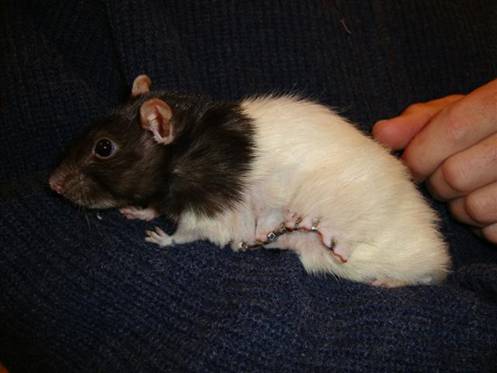
This rat had a large mammary tumor removed
and the incision was closed with Michel wound clips.
Protecting the
Incision
12.
Some rats, especially females, will try to chew out their sutures. Only
incisions over 1 ½ to 2 inches long need extra protection. If a rat chews open
an incision this size or smaller, the best choice is to leave it alone to heal
on its own. The exception to this is a spay incision, where further chewing can
result in disembowelment, or any other incision in an extra vulnerable spot.
Here is a series of photos that shows how well an incision healed when Winston
chewed it open after a tumor was removed. Owner
Kathryn Holtkamp originally tried to bandage it, but
after my advice, left it open. Because the incision looked infected, on my
advice she put the rat on amoxicillin.
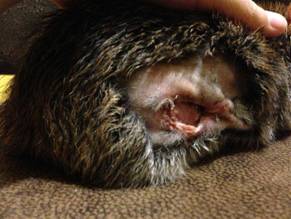
October 26, the day he chewed the incision open.
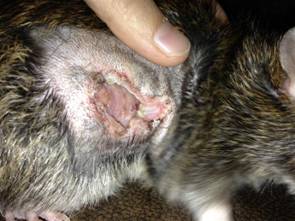
October 27. They started him on amoxicillin.

November 2.
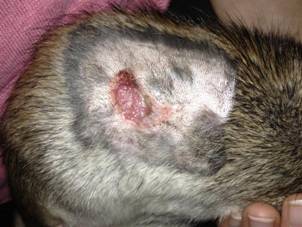
November 6.
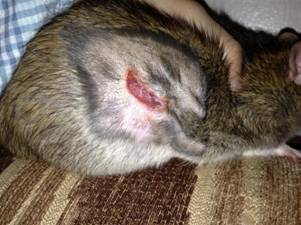
November 9.
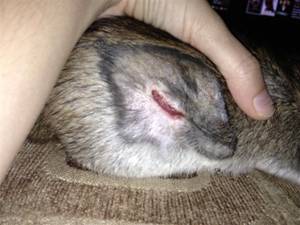
November 12.
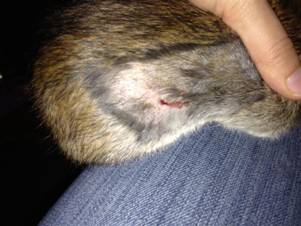
November 15.
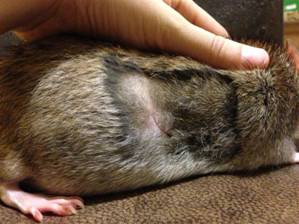
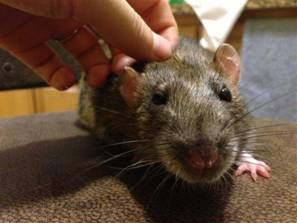
November 18, all closed!
The most effective methods to protect an incision are with a tape body wrap
or a cervical collar. However, I do not
recommend the routine use of these methods for every surgery. These restraints can be quite upsetting for
the rat so they should only be used if the patient has a history of chewing her
incisions open, has actually chewed open an incision longer than 2", or if
the incision is longer than 2" and the owner would have trouble getting
back to the hospital to have an opened incision re-closed. An open incision 2" long or less can be
left open because it will quickly heal on its own, even if the skin gapes open.
*****An Elizabethan collar, commonly used in dogs and cats, should ONLY
be used in rats to prevent scratching of the eye or ear in life-threatening
situations. It should not be used to
protect a body incision because it prevents grooming of the face, and can also
prevent eating, drinking, and walking.******
Rats who chew open their incision usually do so the first night after
the surgery, so it’s especially important to check the incision the next
morning. An incision open more than 2
inches long should be reclosed. This can be done easily with staples, Michel
wound clips, or surgical glue without the need for anesthetic
or sedation. Putting in
staples or clips is quick and only causes minor discomfort. If you can’t get back to the hospital you can
close a large open incision yourself with Super Glue (see Treating Injuries in
Nursing).
Even if an incision is protected in some way, some rats are masters at
chewing open their incision no matter what.
For this reason, I recommend that all post-surgical rats be kept in a
cage with only shredded paper or fabric—no litter or bedding with small
particles—until the incision is healed to prevent possible contamination.
The Tape Body
Wrap
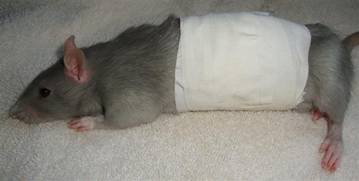
A body wrap works by preventing the rat from bending over to reach the
incision. The body wrap may also
directly protect the incision, but it must still prevent the rat from
bending. If the rat can reach the tape
with her teeth she will be able to chew it off.
The body wrap is more effective than the cervical collar and should be used
if the incision is in the lower abdomen or groin area, but it is also much more
restrictive than the cervical collar. If
the incision is under the armpit or on the shoulders you can use a cervical
collar.
Adhesive bandage tape makes the most secure and comfortable body
wrap. Rats can easily wiggle out of a
stretchy bandage unless it is wrapped over the shoulders and between the arms,
and this actually restricts the rat’s movement more than the adhesive tape.
If the incision will be covered by the wrap, cover it with gauze. Wrap several layers of ¾" or 1"
adhesive tape around the rat’s middle, between the front and back legs,
sticking the tape directly to the fur, otherwise they just walk right out of
it. The wrap should not restrict the
rat’s breathing, but it must be snug enough so the rat won’t get her back feet
caught in it. Apply 3-5 layers of tape
to make the wrap stiff.
The tape wrap will last at least 2 to 5 days, long enough to protect
the incision during the critical healing period. When the incision is mostly healed, if your
rat hasn’t gotten out of the cast herself, you can remove it by cutting the
tape along the back, with the direction of the fur, and putting vegetable oil
on the inside to help dissolve the adhesive. You can also let the rat work her
way out of the tape once you have cut it along the back.
The Cervical
Collar
A cervical collar is not as effective as a tape body wrap, but it is
less restrictive. It prevents the rat
from bending her neck to reach an incision in the armpit, or on the shoulder or
back area. Simply wrap enough layers of
½" adhesive tape snugly around the rat’s neck to make a collar stiff
enough to prevent the rat from bending her neck.
Rat of the Week | News | Rat Info | Adopt a Rat
Reviews | Rat Books | Merchandise | Special Events
Meet the Ratlady
| Links | Home
Rat Fan Club 857 Lindo Lane Chico, CA 95973 (530) 899-0605 ratlady@ratfanclub.org
Copyright 1999-2013