The Rat Fan Club
This article is from the Rat Health Care booklet. Order one today! Check out the info at Rat Books
Skin Problems
by Debbie “The Rat Lady” Ducommun
updated
Male rats tend to produce more skin oil on their backs than females, and some males produce enough skin oil that it can look like a problem to the uninitiated. This oil can appear as orange deposits on the skin of the back, and this is perfectly normal. The oil can even result in blobs of dandruff that can look suspiciously like parasites. However, this dandruff never moves, the way lice and visible mites would do. Some males produce so much “buck grease” that the fur on their back looks unkempt, and it can even cause clumps of fur to fall out. None of this is actually a health problem, although it can be unsightly. Excess oil can be washed off with a little Dawn dishwashing liquid dissolved in water. (Be sure to rinse it off well.) However, the skin will just produce more oil. The only way to eliminate the oil permanently is to have the rat neutered.
The most common skin problem in rats is caused by itching. The rat scratches herself which creates scabs, most often on the neck and shoulders, but sometimes also on the face, chin, or forehead. These scabs are sometimes mistaken for injuries caused by other rats. The most common cause of itching is fur mites. Even if only one of your rats has scabs, the cause is likely mites because rats can have mites without symptoms. Rats can have mites without any symptoms for a long period of time and then suddenly start itching. Maybe they don’t itch until their immune system is suppressed by stress. It’s also possible that some rats with mites eventually develop an allergy to them.
Much less commonly, itching can be caused by an allergy, eczema, a fungus infection, and possibly excessive dietary protein (such as fish or cat food). Skin problems in rats is almost never caused by a bacterial infection.
External
Parasites
There are three kinds of external parasites that can be a problem for rats: mites, lice, and fleas. Lice and fleas are wingless insects, and mites are relatives of ticks and spiders. Any of the three can carry internal parasites or diseases they can pass onto the rat, so it’s important to prevent these pests or get rid of them quickly.
The simplest to identify, although the least common cause of problem in rats, are fleas, which are about 2 mm long. The most common types of fleas are dog and cat fleas (several species) which are dark brown and easiest to see in light colored fur. Rats are not the primary host for these fleas, but if your home is infested with dog or cat fleas, some will be happy to feed on your rat. Even if you don’t see the fleas themselves on your rat, you might see their droppings, which look like black dirt. To tell if they are flea droppings, put some on a damp sheet of white paper. Flea droppings are really digested blood, so they’ll dissolve and turn red, and dirt won’t. You might also see some scabs on your rat where the fleas have been biting.
If your rat has fleas it got them from dogs or cats, so you must treat your other pets, and possibly also your house and yard, instead of the rats.
Rat lice (Polyplax spinulosa) are most common on the back, neck and shoulders where the rat has trouble reaching. They are only ½ to 1 ½ mm long, and narrow so they’re hard to see. They are cigar-shaped, and are usually yellow or tan, but they can have a brown or red spot in the middle. Using a magnifying glass can make them easier to spot. Often it’s easier to see the nits (eggs) which appear as tiny silvery blobs on the hair.
Lice can cause rats to itch and scratch out hair, but don’t usually cause damage to the skin. If there are scabs, your rat might also have mites or fleas. Like fleas, lice suck blood, and both can cause anemia and debilitation. All lice are species-specific and live on only one type of animal (so humans can’t get rat lice and vice versa). They live their whole life on their host, laying their nits on the hair. For this reason, lice can’t reproduce on hairless rats! The life cycle of the rat louse is 26 days, and adults can live 28-35 days.
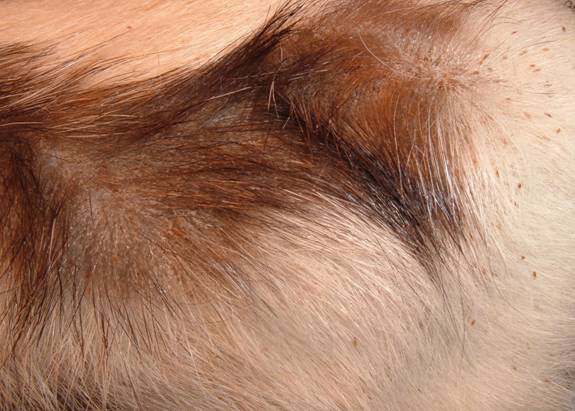
You can see lice on the right side of the photo, and silvery nits in the brown fur on the left.
Mites
Rat mites come in three types. The rat fur mite (Radfordia ensifera) sucks blood and is very common. This mite can cause intense itching, leading to self-inflicted scabs most commonly seen on the shoulders, neck and face. But some rats can have these mites for long periods of time without any symptoms. These mites are too small to be easily seen, but when a rat dies, if you leave the body for several hours, the mites will crawl to the tips of the rat’s fur where you can see them like tiny white specks of dust. Rat fur mites only live on rats and cannot bite humans or other animals.
Fur mites mostly live in the fur, although they can also live under the skin. The mites can sometimes be seen under a microscope on plucked fur and transparent tape pressed against the fur. However, it can be difficult to actually find the mites. Finding the mites with a skin scraping is also equally difficult. The simplest thing to do is just treat for the mites, since the treatment is harmless to the rat.
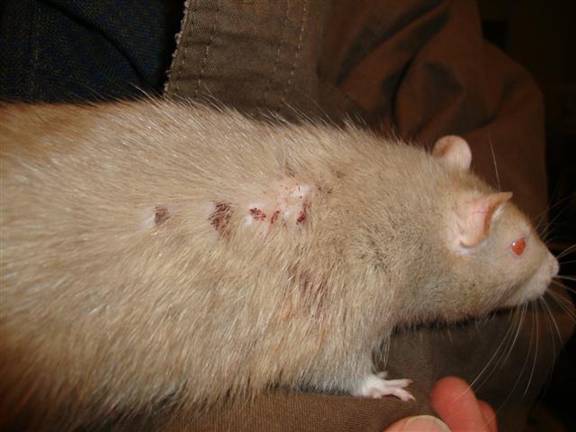
This is a severe case of scabs caused by the rat itching fur mites.
See how tiny these fur mites are compared to the rat’s fur and whiskers.

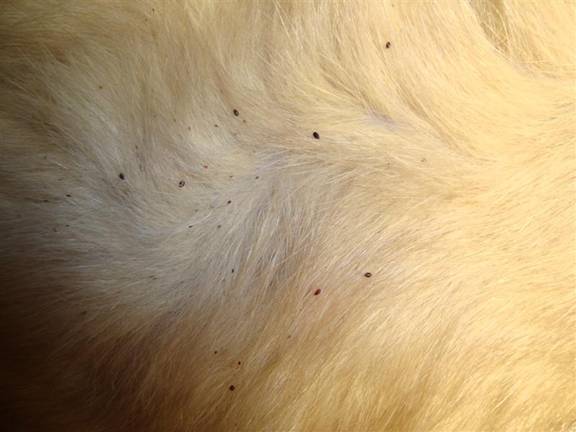
The tropical rat mite (Liponyssus bacoti) is more like a tick and is basically round in shape. The larva are microscopic but the adults range from about the size of a pinprick to 1 mm long when engorged with blood. They usually appear dark red to brown or black. They live in cracks around the rat’s cage and only crawl on the rat to suck blood. This parasite can also bite humans and other animals causing a very itchy welt. Fortunately they are uncommon.
A rat heavily infested with tropical rat mites.
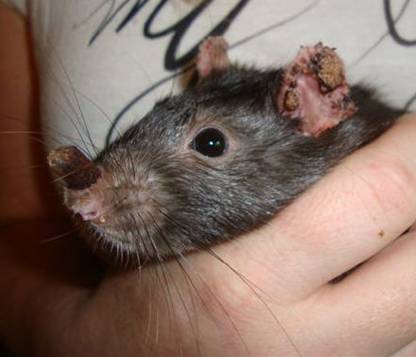
The rat mange mite (Notoedres muris) is rare. It burrows into the skin and causes crusty bumps on the ears and sometimes nose and rarely red bumps or blisters on the tail, feet and genitals. This mite It is microscopic—only 0.04 mm long—so can only be seen under a microscope. It only lives on rats. Nothing else causes the same symptoms.
This is Monty with a very early case of mange mites on his ears.
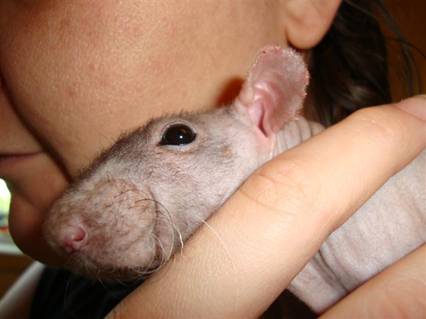
This is a moderate case of mange mites.
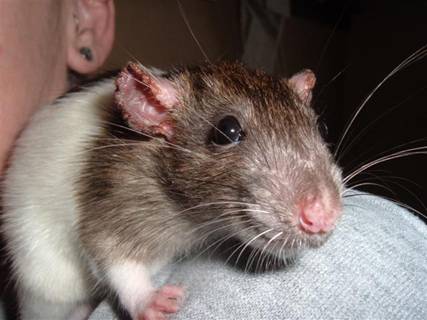
Below is Alfie on May 23, 2010 and then on June 1, 2010.
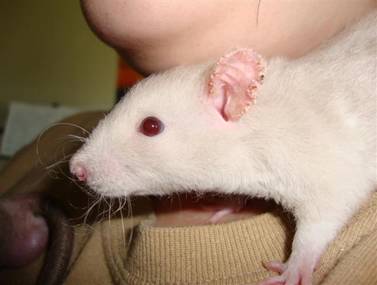
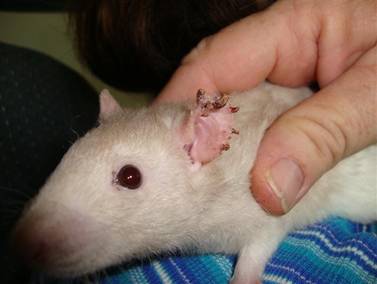
Below is Prancer, with a severe case of mange mites with lesions on his ears, nose and tail. One treatment with moxidectin cleared it up completely.

Parasite Treatment
You must treat all of your rats, since if one rat has fur mites they probably all do, even if they don’t all have scabs. Rats can have the mites without any symptoms.
Mite spray doesn’t work, plus rats hate the spray, and it is quite toxic and causes some rats to have a bad reaction! I also don’t recommend powders because they can’t kill all the mites that live in the skin, and you don’t want rats inhaling the powder. Shampoos don’t work either.
Your vet might want to do a skin scraping to look for the mites first, but often this will still not show the mites, and can be a waste of money. Your vet can also press a piece of tape to the rat’s parted fur and look for any mites stuck to the tape under a microscope. But this method of looking for mites can also be hit or miss. Even if there are no mites on the tape, the rat can still have mites.
An easy treatment for lice, rat fur mites
or mange mites is moxidectin (a relative of ivermectin) which is available from
feed stores or websites as Quest brand horse wormer. The feed stores may not
have it in stock, but they can order it for you, or you can order it yourself
online. I used this product
successfully on several rats with mange mites as well as for fur mites. The dose is 2 mg/lb13. The
amount to give a 1-lb rat is 0.1 ml (10 units on an insulin syringe). The Quest
product is a clear oral gel that is easy to suck into an insulin syringe (with
the whole top broken off) for accurate measurement. If you can’t get an
insulin syringe (say from a friend with diabetes) then you can try to judge the
right amount by size. For a 1-lb rat, the dose is a dab about the size of a
dried pea. It tastes nasty, so the
most reliable way of dosing it is to force it in the back of a rat’s
throat. But you can try smearing it
on a small square of graham cracker and covering it with jam; some rats will
eat it this way. Separate your rats to make sure they each only eat their own piece.
Moxidectin stays in the rat’s body for a long time, so just one dose is
enough to kill lice, fur mites and mange mites. It will also kill roundworms
such as pinworms. I’m not sure if this dose of moxidectin will kill
tropical rat mites or not.
Most vets still want to treat fur mites
with ivermectin. However, I’m
finding that most fur mites are now resistant to it. It might help for a while, but the
problem usually comes back. Ivermectin can also be used for lice, it needs to
be given once a week for at least 3-4 weeks, so it is much easier to just use
moxidectin. Most veterinarians will
use ivermectin injections instead of giving it orally and will charge much more
for a series of injections than you would pay to buy the moxidectin yourself
from a feed store
Revolution (selamectin) is a treatment which will eliminate all external parasites, even tropical rat mites, although they require double the normal dose. Unfortunately, in the U.S. Revolution is only available from your vet (with a prescription in the U.S.) However, you can order it without a prescription from Australia at www.joespetmeds.com, www.petsofoz.net and http://www.petshed.com/. In the UK or Australia you can order it from www.pets-megastore.com.au or 1-866-270-2303.
Revolution is a spot-on product, a liquid
that is applied to the skin on the shoulders. After application, you need to distract
your rats so they don’t scratch off and eat the liquid, or lick it off of
each other. The liquid will dry in
about 5 minutes. Only one dose is
needed.
Revolution comes in tiny tubes of
different sizes for different size cats or dogs. Packages of Revolution come with either
3 or 6 tubes of liquid. (If your
vet treats a lot of small animals, he or she might be willing to split a
package and sell individual tubes.)
Each tube costs about the same amount no
matter how much Revolution it contains, so you want to figure out which tube
will treat all your rats. To figure
out what package to buy you will need to weigh each of your rats, total the
number of pounds and multiply that by the dose (6 mg/lb). That will tell you the total number of
milligrams of Revolution needed to dose all your rats. (Please note that this dose is higher
than the dose for dogs and cats. This is because rats have a higher
metabolism.)
Here’s a summary of all the
packages of Revolution:
color size
of pet total
mg concentration
mauve up to 5 lbs 15 60
mg/ml
blue 5.1-15
lb (cat) 45 60
mg/ml
purple 5.1 10 lb 30 120
mg/ml
brown 10.1-20 lb 60 120
mg/ml
red 20.1-40
lb 120 120
mg/ml
teal
(green) 40.1-85 lb 240 120
mg/ml
plum 85.1-130
lb 120
+ 240 120
mg/ml
The dose for the tubes that contain 60
mg/lb is 0.1 ml/lb (10 units/lb).
The dose for the tubes that contain 120 mg/ml is 0.05 ml/lb (5
units/lb.)
The amount of liquid needed per dose is
quite small, and is best measured using an insulin syringe. You can either poke
the needle into the top of the plastic tube, or you can break off the whole top
of the syringe and cut off the top of the tube so you can insert the syringe
into the tube to suck out the dose.
Insert the syringe into the tube slowly as it will easily overflow. Once a tube is opened, it must be used
within a few hours.
Here is a peer-reviewed article on the
Internet about using Revolution in rats in case your vet has objections: http://www.jarvm.com/articles/Vol5Iss3/Beck%2087-96.pdf
I have a report that the product
Frontline (fipronil) did not work
for fur mites in one case. It must be used with extreme care as it is very
toxic to rats if ingested.
If you use it, you must be absolutely sure the rat does not eat any of
it. After applying it, make sure
the rat does not scratch or lick it off until the liquid dries.
Allergies
The most common foods for a rat to be allergic to are peanuts and dairy products, including yogurt drops. Eliminate these items for at least two weeks to see if this solves the problem. If the problem is another allergy, or eczema, treatment with a steroid will stop the itching. You can try a hydrocortisone cream (be sure to rub it into the skin well), or ask your vet for oral predisone an antibiotic should be given with it because steroids depress the immune system). Sometimes the steroid treatment alone will clear up the problem, but if the itching returns after the treatment, you must try to identify what the rat is allergic to.
It is rare for a rat to be allergic or sensitive to most litters, other than pine or cedar shavings, but you might want to try changing your rat's litter or bedding. Because I think a rat can develop an allergy to fur mites, I recommend treating for mites if you can’t identify another allergen.
If you know your rat’s problem is an allergy, the next step is to test for further food allergies. A good testing diet is a mixture of cooked brown rice and raw millet, plus 1 teaspoon of Nutri-Cal per day. You can buy Nutri-Cal at any vet hospital. If you see an improvement in 7-10 days you then add foods one at a time to see if they cause itching. If you identify the food your rat is allergic to, then you can put her back on a normal diet, minus the offending food.
It is also possible for a rat to have eczema, which causes itching with no known cause. The treatment in this case is a topical steroid cream or shampoo, and you often have to continue the treatment for the rest of the rat’s life.
Dermatitis/Eczema
In one case two siblings developed dermatitis with ulcerating blisters that didn’t seem to hurt or itch. A shampoo containing benzoyl peroxide was used 3 times a week until the ulcers started to heal, and then once a week as a preventative.
Fungus
If your rat hasn’t responded to the moxidectin or the prednisone, the only thing left is to treat your rat for a fungal infection. Like the skin scraping for mites, biopsies or skin scrapings for fungus often yield a false negative. Therefore, you must try the treatment.
The fungus infections that can grow on
the skin are commonly called ringworm, because of the red ring they can cause
on human skin. Ringworm is very
contagious and can be passed from humans to other animals and back again. Rats who have a fungal infection of the
skin don’t always show symptoms.
If your rat does have a skin lesion, you can try an over-the-counter
cream. Antifungal shampoos don’t seem to work. I recommend a cream
containing either terbinafine hydrochloride or itraconazole.
For a rat who has widespread lesions, or
for a rat who shows no skin lesions at all, you should use an oral
fungicide. For griseofulvin the dose is 12-25 mg/lb twice a day for
at least 4-6 weeks. Give
griseofulvin with a meal that includes fat. For ketoconazole (Nizoral) the dose is 4 mg/lb three times a
day for at least 3-4 weeks. With
either treatment you should see improvement in 1-2 weeks. In some cases treatment may be needed for
up to 3 months. Program may also be an effective treatment for fungus
(veterinarians are still not sure of this.) Because fungus thrives on sugar, a
rat with a fungal infection should receive only limited amount of sugar
(including fruit) in his diet.
There is a type of fungus called Trichophyton
mentagraphytes that can be passed from animal to humans. It doesn’t usually cause any
symptoms in the animals. In people it usually starts out as a small red
pimple-like bump that develops over several days into a blister. I have had this
fungus several times and in my case, there was no itching, but the lesions are
very tender and painful if bumped.
They may cause itching in some people. This fungus should be treated with a
topical anti-fungal cream twice a day. The sooner you recognize it and treat
it, the sooner it will go away. For
more info see www.ratfanclub.org/fungus.html.
Dry Skin
Dry skin and dandruff can be symptom of a poor diet, or it might be that rat has a higher than normal need for essential fatty acids. You can buy a supplement of essential fatty acids to add to the diet at either a health food store, or a pet store. (Look for ferret supplements.) Dry dandruff can also occur in rats with hindquarter paralysis since they can't groom themselves normally. If the humidity in the air is too low, it usually affects the tail rather than the skin. This can prevent the dead skin cells on the tail from shedding properly resulting in patches of scaly skin and discoloration. The solution is to scrub the dead scales off the tail.
Ringtail is a skin problem caused by dehydration that is occasionally seen in baby or hairless rats, and rarely in haired adults. Dehydration can occur if baby or hairless rats are kept on litter that is too absorbent (commonly corn cob litter) or in any rat if the water bottle malfunctions. In babies ringtail causes a constriction at the base of the tail. In adults it can cause a moist oozing sore at the base of the tail. The problem usually goes away when the rats are rehydrated, although if the problem is bad enough a baby may lose part of her tail.
The picture on the left shows a tail with excessive unshed scales which should be picked or scrubbed off. The second picture shows numerous scabs on the tail. I’m not sure what causes this, but suspect it might be little infections caused by poor tail hygiene. It might also have been a case of mange mites that didn’t affect the ears and nose. I’m not sure the best treatment, but suggest trying soaks of diluted Betadine and/or Epsom salts. You can also try rubbing on grapefruit-seed extract.


This is Ruckus, a rat with an infection in the end of his tail that was successfully treated with amoxicillin.
Hair Loss
There are two main causes of bald spots in rats. The most common is barbering, a behavior where a rat obsessively grooms itself or another rat to the point of nibbling off the hair. The result is bald patches or areas where the hair looks like its had a bad haircut. Usually there is no damage to the skin, but sometimes there can be scabs. The most common areas for self-barbering are the front legs and stomach. The most common areas for barbering another rat are on the head, face, neck, and shoulders. These bald spots are not usually symmetrical. Because this behavior doesn't usually cause any health problems, there is no reason to separate a barber from her roommates, unless you are showing your rats. Another cause of bald spots is fungus (see above.)
Another type of hair loss is a general thinning of the hair. This can occur in a rat infested with lice or tropical rat mites. Although in these cases the rat usually doesn't self-inflict scabs, constant scratching can cause general hair loss, most commonly on the back. Rex rats may tend to have thinning hair as they grow older or if they are stressed due to disease.
In some other animals, such as dogs and cats, a hormone problem can cause hair thinning, although I haven’t seen this in rats. This type of hair loss is usually seen on the flanks, hindquarters and sometimes the stomach and is usually symmetrical.
Adopt
a Rat | Reviews
| Rat Books | Merchandise
Meet the Ratlady | Links | Home
Rat Fan Club 857 Lindo Lane Chico, CA 95973 (530) 899-0605 ratlady@ratfanclub.org
Copyright 1999-2017