The Rat Fan Club
This article is from the Rat Health Care booklet. Order one today! Check out the info at Rat Books
Euthanasia
By Debbie “The Rat Lady” Ducommun
(updated 4/28/17)
The lucky rats who live out their full life spans and then die in their sleep from old age probably do so from kidney or heart failure, or from a massive stroke. But what about rats who seem to be suffering as their lives come to an end? Fortunately, we have the option of euthanasia to help our rats achieve a peaceful death.
When is the right time to end a rat’s suffering with euthanasia? This is
always a difficult and very personal decision. In my opinion, the time to help
your rat die is when there is no hope of improvement through the use of
medications or surgery, and he is no longer enjoying life. If his illness takes
all his energy and concentration; if he shows no interest in food or physically
can’t eat, even with help; if he seems to be constantly in pain, distress,
or misery; or if he has episodes of respiratory distress that cannot be
controlled with medication, this is the time to say goodbye and let your rat go
on to a better place. Although it
hurts, you know it’s the kindest thing to do as a last gift to a friend
who has given you so much.
It is always most comforting for your rat if you hold or pet him as he gently
falls unconscious. Most vet hospitals and animal shelters can euthanize
animals, but you should first discuss the method they use for rats. If they
won’t let you be present during the procedure, go somewhere else. When
euthanasia is done correctly, there is no reason why you should not be present
to comfort your rat.
If taking your rat to the vet or a shelter for euthanasia, consider taking along a roommate for comfort. After the euthanasia, I recommend letting the surviving roommates, or any other rats who interacted with the deceased, a chance to see the body so they know the rat died and didn’t just disappear. Most of the time, the survivors simply sniff the body all over and then go back to their regular routine. Occasionally, a rat will take longer to process the death and say good-bye to the body.
Methods of Euthanasia
Before discussing the methods I recommend, I want to list the methods that should not be used. According to the “AVMA Guidelines on Euthanasia,” published in June 2007 on the American Veterinary Medical Association website at www.avma.org, “Intramuscular, subcutaneous, intrathoracic, intrapulmonary, intrahepatic, intrarenal, intrasplenic, intrathecal, and other nonvascular injections are not acceptable methods of administering injectable euthanasia agents.” To translate this for the layman, this means that injections of euthanasia solution into the muscle, under the skin, inside the chest, inside the lungs, inside the liver, inside the kidney, inside the spleen, into the brain or spinal cord, or into any other tissue, is not acceptable. Injecting fluid into tissue or an organ is extremely painful.
Under no circumstances allow anyone to administer an intracardiac
(IC; in the heart) injection to a conscious rat, even if the rat is sedated.
Unfortunately, this euthanasia method is commonly used, but it is not
humane. It is also illegal in
Here is the euthanasia method I like to use as long as the rat is not in
respiratory distress. First, give
the rat diazepam orally or by SQ injection, either with a 1 cc tuberculin
syringe with a 27-29 gauge needle or an insulin syringe. When a SQ injection is
administered in the flank area, the rat rarely seems to feel it. Once the rat
is sedated, an intraperitoneal injection (IP; in the
abdomen) of the correct dose of sodium pentobarbital is administered, also with
a 27-29 gauge needle or insulin syringe. This injection should be given in the
lower right side of the abdomen in order to avoid causing pain by hitting the
liver or any other organs. If the IP injection is administered correctly, it
will cause almost no discomfort, because the liquid goes into the empty space
of the abdominal cavity and not into any tissue. In fact, a rat will rarely
even flinch if a small enough needle is used and the skin at the injection site
is scratched with a fingernail first to distract the nerve endings. I also have
given the IP injection of sodium pentobarbital without any sedation without it
causing any obvious pain. The
euthanasia solution will be slowly absorbed into the rat’s system and
loss of consciousness will usually occur within 5-10 minutes, although it can
take 15 minutes or longer for the heart to stop beating. This gives you the
opportunity to hold, cuddle and talk to your rat as he gently slips away.
Many people prefer to euthanize their rats with a gas anesthetic; however, rats
do not like breathing in the gas anesthetic. Also, you may not be able to hold
and comfort your rat during the process.
To euthanize in this way, the rat must either be placed in a small
closed chamber, or a gas mask must be forced over his face. Do you want that to be the last thing he
experiences? However, giving your
rat his favorite treat might distract him enough so he doesn’t mind the
gas in the chamber. Sedating the rat first also helps.
Consider asking the veterinarian to anesthetize your rat with the gas, inject
the euthanasia solution in the abdomen while the rat is anesthetized, and then
let the rat wake from the gas so the last thing your rat experiences is your
cuddling him. If, however, a rat is experiencing respiratory
distress, then euthanasia with gas anesthetic is the only recommended
method because an abdominal injection is slower and can cause increased
respiratory distress. Sedation can also increase respiratory distress
and is not recommended for a rat in respiratory distress.
Recently, a rat owner said that her vet told her that using gas anesthesia to euthanize her rat would be too expensive, so did it instead with an injection to the heart. It seems that many vets have switched to using a new type of gas anesthesia, called sevoflurane, which is much more expensive than older types of gas anesthesia. However, older types of anesthesia, such as isoflurane, still work just fine for euthanasia, and are much less expensive. The cost for the amount to euthanize a rat is only about $2. So, if you want your vet to use gas anesthesia to euthanize your rats, ask your vet to order a bottle of isoflurane (about $45) to have on hand. If stored in a freezer, it will last at least a couple of years.
Home Euthanasia
The only humane way to euthanize a rat at home without veterinary help is with
carbon dioxide (CO2). Euthanasia with CO2 is approved by the American
Veterinary Medical Association (AVMA).
Concentrated CO2 is a central nervous system depressant and actually causes
anesthesia. You know how you yawn when you’re sleepy? This is the body’s way of getting
rid of excess carbon dioxide in your system which is making you sleepy. CO2
does not cause suffocation. The rat will be able to breathe normally, will
become anesthetized and will then die.
The key to using CO2 humanely is its concentration. The normal concentration of
CO2 in the air is only 0.038%. According to the 2000 Report of the AVMA Panel
on Euthanasia, breathing concentrations of 7.5% increases the pain threshold,
and concentrations of 30-40% cause anesthesia (unconsciousness) within 1-2
minutes. However, concentrations of 50% or higher irritate the eyes and
respiratory tract and cause pain. Your goal is to create a concentration of
30-40% CO2 and hold it there until the rat is unconscious.
At first I used a cylinder of compressed CO2; however, with this method, the
concentration of CO2 can easily get too high. (Using dry ice is not recommended
because the CO2 amounts cannot be controlled and it also can cause severe
burns.) Then I learned of a website
written by Eric Lee of Maralee Rattery
in
The vinegar and baking soda method is quite simple and even better than using
compressed CO2 because the concentration of the CO2 can be more precisely
controlled. I have modified Eric’s method so it is suitable for
rats. I have euthanized many rats
with this method. If you want to
test this method before using it, you can use a short candle to stand in for
the rat. The CO2 will put out the
candle.
Here is an email from rat owners who used this home method:
Dear Ms. Ducommun,
My
husband and I only started adopting rats a couple years ago. When we started,
your books were recommended to us and we read them with joy. We also came
across several articles published by you, and in a way you have been a fairly
constant presence to us as rat-caretakers. I wanted to send you a thank you
because tonight you have once again been a huge help and comfort to us.
Recently,
one of our rats,
I
cannot tell you how strange it feels to be comforted by the manner of my
pet’s death, but being able to sit and talk to her, watch over her, and
see with my own eyes that she simply fell unconscious and slipped
away—all while not having to add to her trauma
My
husband and I would like to thank you from the bottom of our hearts for helping
us continue to be the best caretakers that we can. Thank you so much. Thank
you.
Best wishes,
Colleen and Kyle Wilson
For more comments from people who have used this method, good and bad, click here.
Warning: A few people have reported that their rats have reacted very badly to this method of euthanasia, but most have reported that the method worked well. Since posting this information, I have learned of research which shows that some rats appear to suffer a feeling of breathlessness with relatively low levels of CO2, while others seem to have no such feeling. One person has reported that when her rats have started to panic, gently blowing in their face has stopped the panic. Since you cannot anticipate which rats will experience this, perhaps it would help if you are able to give the rat a sedative before hand. You should decide ahead of time what you will do if your rat does seem to experience panic during this method. You can either remove the rat from the aquarium and end the euthanasia attempt, or try to add more CO2 as quickly as possible to shorten the time to unconsciousness. If your rat moves around a lot inside the aquarium, or tries to run up your arm, this will stir up the CO2, so please be prepared to add extra vinegar and maybe extra baking soda, to replace the CO2 lost from the aquarium.
PLEASE NOTE: These instructions require a 10-gallon aquarium or an airtight container of the same size, such as a cooler, to create the proper concentration of CO2. If you must use a container of a different size, you must adjust the amounts of vinegar and baking soda proportionately. The aquarium I use measures 10 inches X 20 inches X 12 inches tall (25.5 cm X 51 cm X 30.5 cm tall) which is 2400 cubic inches (39,665 cubic cm). One rat owner reported that a container only 8 inches tall (20.5 cm) did not work correctly. (10 gallons is about 38.6 liters.)
You will need a 10-gallon aquarium or a container of the same size in order to
follow these instructions and to create the right concentration of CO2.
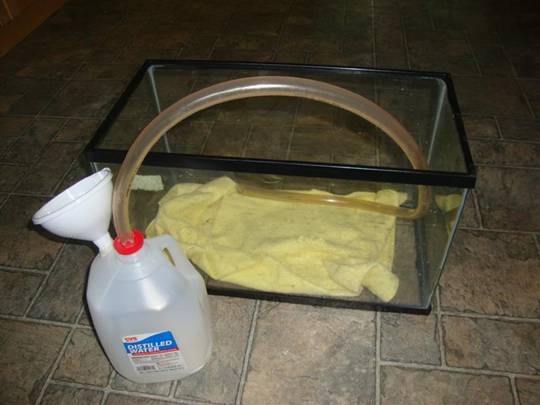
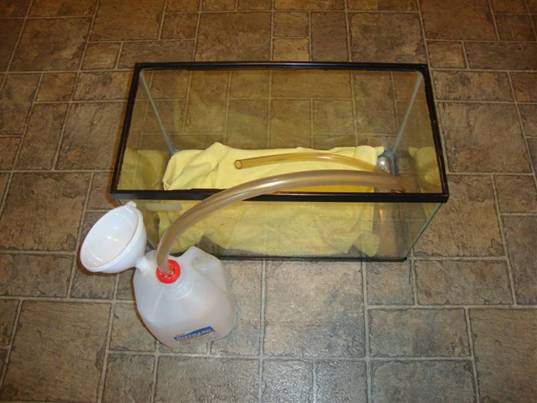
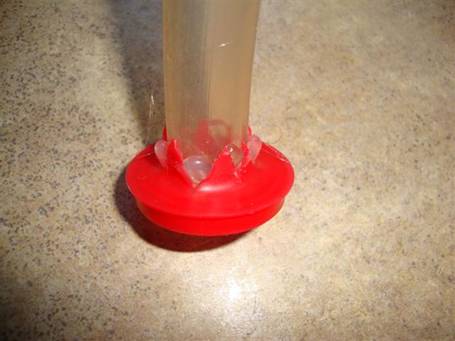
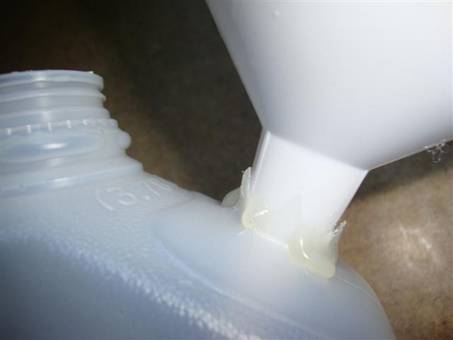
You will also need to put together a plastic gallon jug, a funnel and a ¾-inch (12-20 mm) tube 3 feet (1 meter) long. See the pictures. You can buy the funnel at a dollar store, and the tube at a hardware store. You will need a cotton ball to plug the funnel.
With sharp scissors cut a star shape in the lid of the jug to insert the tube. Then cut a star shape in the top “shoulder” of the jug to insert the funnel. Glue these in place to prevent the CO2 from escaping around them. I used hot glue and it worked well.
You will also need:
2 containers containing 2 cups of white vinegar each (a cup is equal to 240 ml), 4 cups of vinegar total
5 tablespoons of baking soda (make sure it is fresh!)
(If your rat weighs more than 1 ½ lbs., you need to use an additional 1 ½ tablespoons of baking soda and an additional cup of vinegar at the end.)
When buying baking soda, it is a good idea to buy at least 2 or 3 boxes as sometimes one box won’t be as fresh as it is supposed to be and you will need to try another box.
Set-up: Place the aquarium where it will be comfortable for you to sit next to it, with your arm inside. The aquarium doesn’t need a lid because CO2 is heavier than air and will stay inside as long as there is no strong air movement. This means you can slowly put your hand in to pet and comfort your rat during the process.
Put the baking soda in the jug. As long as the funnel is dry, the baking soda will go through the funnel. If it gets stuck, poke it down with a chopstick. Put the cap on the jug and run the tube from the jug to the bottom of the aquarium. Place a cloth in the aquarium for your rat to sit on. You can give your rat a treat if you like.
Step 1: While you pet your rat with one hand, slowly pour 2 cups of vinegar into the jug through the funnel with the other hand. It helps to hold the jug between your knees. After doing this, plug the funnel with the cotton ball. The combination of the vinegar with the baking soda will cause fizzing, creating the CO2, but you won’t see any vapor.
Step 2: When the fizzing begins to slow down (about 1-2 minutes), pour about half of the vinegar in the remaining cup into the container. Shake or swirl the jug to thoroughly mix the vinegar and baking soda.
Within 1-2 minutes your rat will become groggy, lie down, and go unconscious. The eyes will probably stay open because it requires muscles to keep them closed and at that point all the muscles are relaxed. Gently touch the inside corner of your rat’s eyelids to test if he is unconscious. A conscious rat will blink, but there will be no blink reflex when a rat is unconscious. An unconscious rat is not aware and cannot feel anything. You may see muscles twitch, but these are just reflexes and your rat is not aware of them. At the very end you may see your rat taking reflexive gasping breaths. Don’t let this upset you, it is just the body’s last ditch effort to breathe on its own because it is no longer getting any messages from the brain. It won’t last for long.
Step 3: Once your rat is unconscious, pour the rest of the vinegar into the jug and mix it up really well with the baking soda. Cover the aquarium with the towel so it won’t be disturbed and leave your rat there for at least 20-30 minutes. You can confirm death by feeling the chest for a heartbeat. The most reliable method to determine death, however, is to wait until the body stiffens.
NOTE:
There have been a few cases where people have followed these instructions, and the rat goes unconscious, but does not die. In most of these cases, it seems that the baking soda was not as fresh as it needs to be. When the people bought a new box of baking soda and tried again, it worked. If this method fails for you, you can contact me so we can try to figure out what went wrong, if you want to try again. Otherwise, you will need to find another method of euthanasia. Even if this method fails, it will not cause your rat any pain, and it is very unlikely that a rat would experience brain damage if this method of euthanasia fails.
Rat of the Week | News | Rat Info | Adopt a Rat
Reviews | Rat Books | Merchandise | Special Events
Meet the Ratlady
| Links | Home
Rat Fan Club
Copyright 1999-2017