The Rat Fan Club
Rat Cages and Toys
by Debbie "The Rat Lady" Ducommun
updated
A rat cage should be as large as possible to allow for exercise and play. The more time your rats spend in their cage, the larger it should be. A rat cage should be at least 14" X 24" X 12" tall. Ideally a rat cage should be 18" X 30" X 18, or even larger and tall enough to include toys such as branches to climb on, a wheel, a hammock, tubes, ladders, etc.
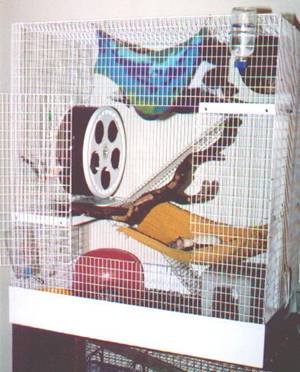
This cage made by Fern Manufacturing (which unfortunately is no longer in business) is 21" X 30" X 35" high and is furnished with a Wobust Wodent Wheel, an igloo, 3 hammocks, a plastic pitcher (hanging top right), a branch and a small concrete block. Seven rats live in this cage but wouldn’t pose (you can barely see 2 of them in the lower hammock.) This cage is taller than it really needs to be.
I suggest placing the cage in a room where the family gathers in the evening, away from windows, and not too close to heaters or air conditioners. Also, it's important for rats to have a period of darkness at night. Constant light will cause reproductive abnormalities, including cystic ovaries in females, which can be fatal. This means there should not be a night-light in the rats' room.
The Advantage of
Wire Cages
Wire cages provide better air circulation than aquariums, which is a health advantage. With more air circulation ammonia won't build up as fast (although it's still produced). A wire cage also allows the rats to interact more with people and smells outside the cage, offers more opportunities for hanging toys in the cage, and allows the rats to climb the sides. For these reasons, I recommend wire cages over aquariums. However, you should choose the type of cage you are most willing to clean.
Elevated wire floors should not be made of 1" by ½" mesh. This mesh is just the right size and shape to trap a rat's back foot, which can result in a wrenched or broken leg. It's even possible for rats to get a foot caught while climbing the sides of the cage, although this is rare. Elevated floors made of ½" square mesh, preferably coated with vinyl, PVC, or powder coated, are okay, although solid floors are better for their feet. You can cover wire floors with plastic needle-point canvas from a craft store to make them safer. This material is inexpensive and easy to spray clean. It can fastened to the floor with twisty ties.
The sides of a cage for adult rats can be made of 1" x 1" or 1" X 2" mesh or bars spaced ½" apart. Cages for baby rats should be made of ½" square mesh or bars spaced less than ½" apart.
Aquariums need to be quite large for good ventilation. The best thing about a large aquarium is that you can often leave the top off, or just have a partial top so your rats can come out on the top to interact with you. They usually won’t try to jump off, and they can't climb down the glass like they can on a wire cage.
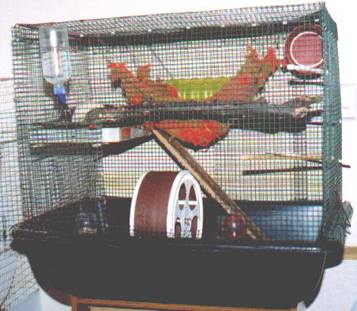
This homemade cage is 18" X 28" X 30" high. The bottom is a cement mixing tray. The mesh is vinyl-coated ½" square mesh. It is furnished with a Wobust Wodent Wheel, a shelf, a ladder, a hammock, a hanging tube (behind the hammock), a branch, and a plastic pitcher (hanging top right.) Dowels placed in the corners on the right help the rats navigate up and down.
Buying Cages
It can be difficult to find good rat cages for sale. Some ferret cages can work for adult rats, but smaller rats can sometimes get through the bars. Rabbit cages can work, but they usually have wire bottom floors, which aren’t recommended for rats. See if the wire floor can be removed.
Most large commercial cages are quite expensive, although if they are well made, they can last for many years and therefore can be a good investment. However, it is also fairly easy to make your own cage and much less expensive. You will find several different plans for making your own cage on our website.
The best wire cages are powder-coated or have the metal otherwise coated. This protects the metal against the corrosive urine and makes the cage easier to clean, and also protects the rats' feet from the abrasive metal.
Look for a cage with a bottom pan at least 2" to 3" deep to keep the litter and bedding in the cage. Watch out for cages with sliding trays, because urine can get under the tray and make a big mess. Heavy plastic pans are usually better than metal trays since they can have rounded corners and are more resistant to urine.
However, one style of cage that is currently very popular is the Critter Nation from Midwest Homes. These heavy-duty metal cages have shallow plastic pans, but many rat owners, including myself, have found it works well for many rats to line the trays with cloth, such as bathmats (no rubber backing) or blankets and wash them frequently rather than using litter. If you want to use litter, you can order 3 inch deep metal pans from these websites:
http://www.chinchilla.ca/detail.php?ProductID=MW6000
http://www.bassequipment.com/foundations/store/scresults.asp?category=245*Critter_Replacement_Pans
Upper stories are nice in a big cage, but they can reduce the options for putting toys in the cage. Look for cages with removable shelves. That way you can arrange the cage in different ways. It's nice to change the arrangement of the cage occasionally to give your rats some variety.
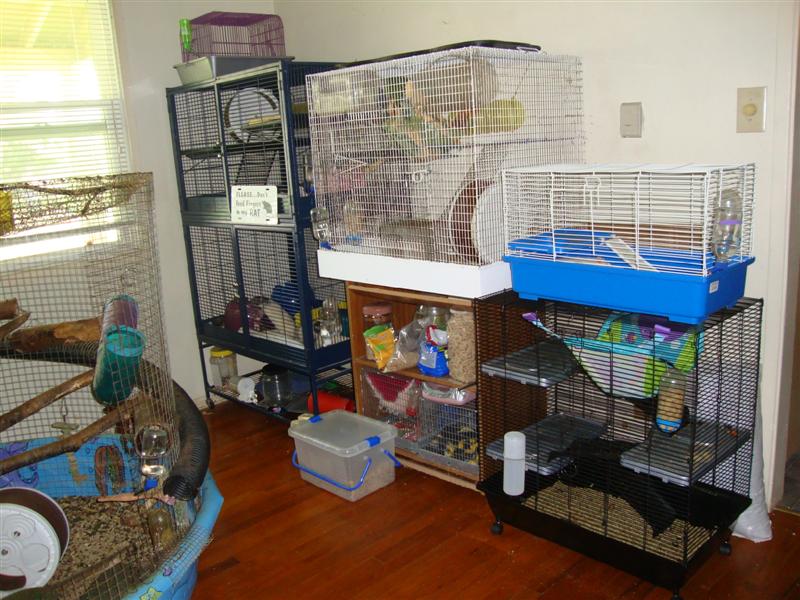
Here are a variety of different cages. The black cage in the back corner is similar to a Critter Nation made by Midwest Homes. Notice the Lixit FoodHopper clearly visible in the front of the black cage on the right. I highly recommend these food dispensers for rat blocks, and sell them on the Merchandise page of this website. The cage on the left of the picture is a giant round cage using a kid’s wading pool as the bottom, and you’ll find plans to build it on this website.
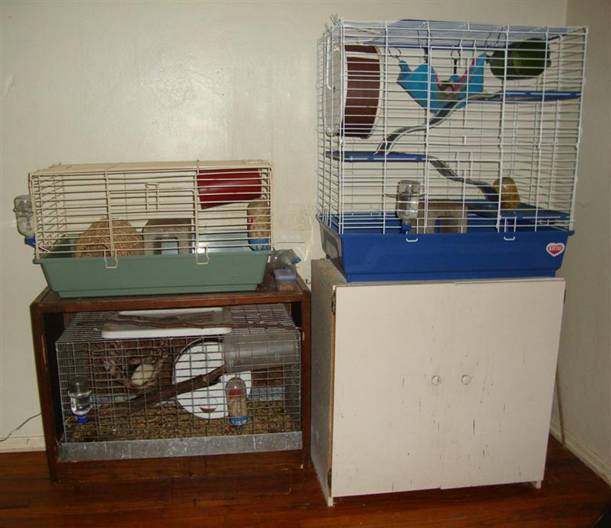
The cage with the blue bottom is made by Kaytee and is a nice cage. However, I recommend drilling quarter-inch holes in each corner of the plastic shelves to allow urine to drain out. The two smaller cages are occupied by older single rats who refuse to live with others. Notice the rats in the hammocks. The rat in the green cage refuses to use a hammock and prefers his grass ball.
Martins Cages
A company called Martins Cages has pretty good rat cages for sale on the internet.
I recommend one of their powder-coated rat cages #R-680 or #R-685. Their
smaller cages can be used for travel cages, but are not large enough in my
opinion for regular homes. Their website doesn’t say, but the elevated
floors on their rat cages are made of ½" square mesh, not the
dangerous mesh. However, I
recommend you order the cages without the shelves (see below). Martin’s Cages,
The company can modify many of their cages, adding or subtracting
interior pieces. I recommend
keeping interior levels and shelves to a minimum, as they reduce the number of
climbing toys you can add to the cage.
You can request any type of modification to your order in the
“special instructions” box on their shopping cart. You can also e-mail them for a quote on
a modified cage. They will normally
deduct $15-20 (depending on the cage) off the price of a cage if a customer
doesn’t want the interior features.
Martins cages that are shipped need
to be assembled, and they normally come with c-rings. With each cage the company sends a pair
of c-pliers which are small
and “disposable,” and are not the easiest tool to use. On their Cage Parts & Supplies page
they do sell heavier professional-quality c-ring pliers that makes assembling
the cages easier ($14.25). They
also sell Ferrules (also known as J-clips; $1.75/lb) and a similar item called
Quick Clips ($2.50/lb) which you can use instead of the c-rings, and the
special pair of pliers to apply them ($14). I have used J-clips to make several
cages and they are fairly easy to apply with the special tool. It does also help to have a pair of
needle-nose pliers on hand.
Especially if you don’t have someone to help you assemble the
cage, you might want to use wire twist ties to hold the panels together, either
temporarily or more permanently.
You could also use lots of plastic Zip ties either temporarily or more
permanently, replacing them if the rats chew them.
Other Cages
For a good
review of other cages that are out there, look at http://www.cavycages.com/commercialcages.htm and http://www.cavycages.com/petstorecages.htm
This website is for guinea pigs, and most of these
cages are way too small for guinea pigs, or otherwise unsuitable, but some of
them are fine for rats.
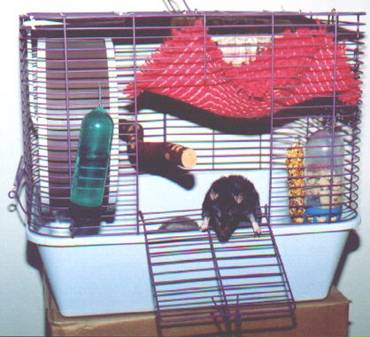
This cage is 12" X 18" (it bulges out a bit more at the middle) X 19" high and is furnished with a Wobust Wodent Wheel, a hammock, a branch and a plastic pitcher (hanging behind the hammock.) At lower right is a hanging seed treat stick and a Lixit FoodHopper holding rat blocks. This size cage is really best for just a temporary cage for one or two rats. Joey is the model.
Hammocks
Almost every rat cage should be furnished with a hammock. I’ve had a few rats who couldn’t have a hammock because they would destroy it within days, but although most rats will chew on their hammock, in most cases a hammock will last a long time. The easiest way to make a hammock is to cut a square or rectangle from fleece or t-shirt fabric, which don’t unravel. You can cut up an old t-shirt, and look for pieces of fleece in the remnant section in a fabric store, or just cut up an old sweatshirt or robe. Put a safety pin in each corner to hang it from. You can then hang it in the cage with 4 more large safety pins, or large paper clips, or shower curtain hangers. An open hammock like this works best during warm weather. In cold weather, rats prefer a double layered hammock so they can sleep inside. To make one of these, cut the fabric twice as long as the finished hammock, and fold the 2 ends over so they meet in the middle. Pin the 2 corners together with safety pins, and then you will have a double-layered hammock with a slit in the top for access. You can also just cut 2 pieces of fabric the same size and layer one on top of the other, and then the rats can climb into the hammock from the sides.
Toys
Because rats are so intelligent and active, toys are not an option, they are a necessity! Rats enjoy toys that they can climb on, in, over, and through such as tubes, boxes, ladders, branches, hammocks and ropes. Look in pet stores for bird toys. These items can be arranged creatively in the cage, with tubes hung on the side of the cage, etc., to keep the floor of the cage clear for running and playing. If the cage is big enough, a great toy is a concrete block, which will help keep their toenails short. There are also bird perches made of concrete that can be attached to the side of the cage as a ledge to wear down their toenails.
One of the best toys is an exercise wheel. Almost all rats will use a wheel to some extent, especially if they have one when they're young, and some rats really love them. As long as the wheel is large enough, at least 11" across, running on it will not injure a rat's back.
However, I don’t recommend wheels made of wire bars, as these can catch and injure legs or tails. You can sometimes find solid metal wheels, or there is a solid plastic wheel called the Wodent Wheel that is wonderful. Some pet shops carry it, and you can also order it from some websites listed on our Merchandise page. It comes in 3 sizes, Junior, for hamsters and mice, Senior for small rats, and Wobust for larger rats.
Some rats enjoy small toy balls, especially those with noise-makers in them, and other small items that they can carry or push around the cage. Look in pet stores for cat toys. Balls made of rope also work well but avoid toys made of soft rubber. Some rats like stuffed animals and carry them around and sleep with them, while other rats just chew them up.
You should offer some chew toys for your rats. Some rats like rawhide chews, and most like wood and cardboard chew toys. All bones, even chicken bones, are safe for rats.
There are a variety of food toys that can make rats work for their food and keep them occupied. We sell one called the roller basket toy on our Merchandise page, or look in your pet store for bird toys. You can also make your own by putting food inside a crumpled piece of paper, or inside a cardboard toilet paper tube with the ends folded in.
If your rat cage is large enough, a great toy is a digging box half filled with potting soil.
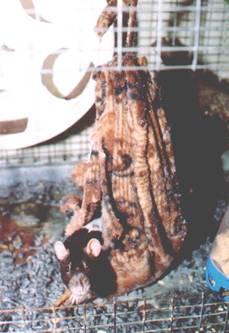
Brisby peeks out of her cozy hanging hut hammock.
For a picture of my giant round cage and its furnishings go to www.ratfanclub.org/cagepln2.html
Rat of the Week | News | Rat Info | Adopt a Rat
Reviews | Rat Books | Merchandise | Special Events
Meet the Ratlady
| Links | Home
Rat Fan Club
Copyright 1999-2016