The
Rat Fan Club
This article is from the Rat
Health Care booklet. Order one today! Check out the info at Rat Books
Abscesses and Cysts
by Debbie “The Rat Lady” Ducommun
Updated
Tumors are common
in rats, but so are abscesses and cysts.
If you suspect a lump on your rat’s body is a tumor,
it’s worth it to wait 2-4 weeks to see if it is an abscess or cyst
instead. Most abscesses are fairly
harmless and either clear up on their own or with minor treatment. Generally cysts are also harmless. Abscesses can “pop up”
overnight and they tend to grow more quickly than cysts or tumors. With most tumors
on the body the skin moves slightly independently of the lump, but abscesses or
cysts are usually inside the skin so moving the skin moves the lump.
Abscesses are usually small infections,
often caused by bite or scratch wounds, which the skin encapsulates to
isolate. The wound usually heals
before the abscess appears. However, sterile abscesses can be caused by
inflammation due to an injury or a foreign body, such as sutures. After a rat has been neutered, a sterile
abscess in the scrotum is common and can be treated as a simple abscess.
It is fairly common for male rats to
develop abscesses in the groin area.
These often are noticed only after the abscess opens and drains and
therefore appear as a hole in the skin.
In most cases, groin abscesses heal quickly once they open and drain.
An abscess on the face, in a tooth
socket, or near lymph glands, can be more serious, often indicating a
cancer. An appropriate oral
antibiotic should be given for a serious abscess; start with amoxicillin.
An abscess that won’t heal after a
week or two of treatment may be a cyst, a sterile abscess caused by a foreign
body, or it may indicate a cancer, such as squamous
cell carcinoma, especially on the face. You can try to treat a cancer with
prednisone at 1 mg/lb twice a day, which in some cases can shrink or slow the
growth of a tumor, and try to control the infection
with amoxicillin, but there is no cure.
A Simple Abscess
In rats, an abscess on the body
(including the scrotum) can usually be allowed to progress on its own. The body
has a natural healing process to open the abscess so it can drain. This process
may take several weeks, but as long as the rat seems well and isn’t
bothered by the abscess you don’t have to do anything. Abscesses on the
underside of the body generally progress more quickly because gravity helps the
opening process. Abscesses on the back can take much longer to open.
The first sign that the abscess is
starting to open is often a dark area on the top of the lump. Most commonly, the skin on the top of
the lump will die and turn dark, hard and “crunchy.” Eventually the
disc of dead skin will fall off leaving a hole, often quite a large hole,
leading to a pocket. This is all okay.
In most cases, the pus will drain out and
the rat will lick the pocket clean, so you don’t have to do
anything. The hole will usually
heal up in a few days. Sometimes,
the dead skin will not come off completely and will need to be cut away.
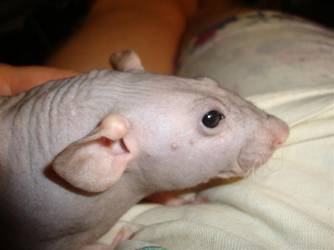
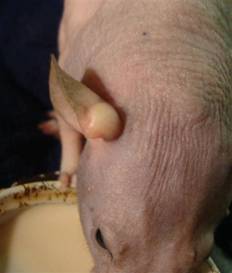
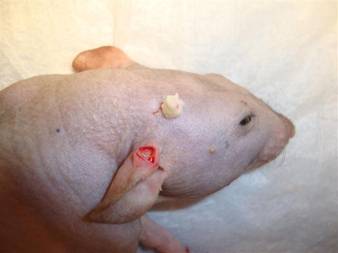
This small abscess on my hairless
rat’s ear took quite while to open.
I took the first photo on
Here is a sterile abscess that developed
after a neuter due to a reaction to the sutures. See the dark spot where the hole will
form. (Note to veterinarians: because such abscesses are common, I
recommend the incision for a neuter be done at the
distal end of the scrotum and not so close to the penis.)
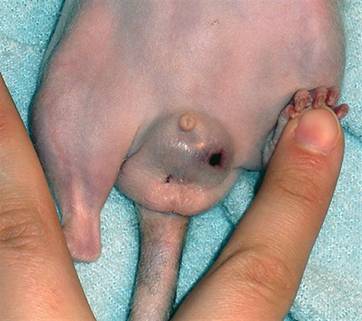
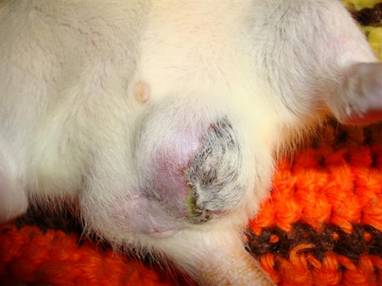
Here is a series of photos I took of my
rat Comet who developed a sterile abscess in his scrotum nearly 5 months after
he was neutered! The first two photos were taken on
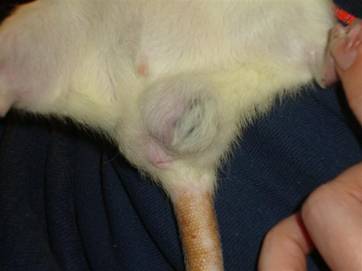
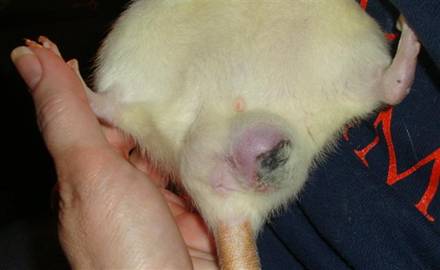
I took the next picture on

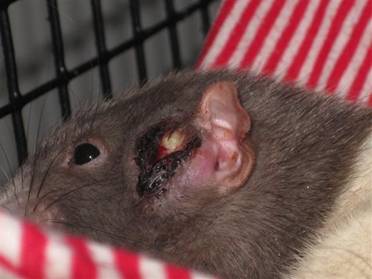
Abscesses that develop under or next to
the ear are likely to be caused by a cancer.
Helping an
Abscess
If you want to speed up the process of a
developing abscess, here are some things you can do. First, carefully trim the hair away from
the lump; then apply a hot compress twice a day to help bring the infection to
a head so it will open and drain. To make a hot compress, wet a cloth with
water as hot as you can stand, or fill a latex glove with hot water. To
reheat the compress, microwave it for a few seconds. Always test the temperature on your
forearm first; then hold it against the lump for as long as your rat will let
you. You can also apply an acne treatment containing benzoyl
peroxide, or Swedish bitters (an herbal mixture), to the top of the abscess
daily to help it open.
Treating an
Abscess
In some cases when the abscess is open,
the pus will be too thick for the rat to clean out so you need to clean the
abscess by gently wiping out all the pus with a cotton swab. This usually does
not cause the rat pain. If it does, try applying some Bactine.
If you can’t get all the debris out of the abscess you
can flush the wound with Betadine diluted with 5
parts water or hydrogen peroxide diluted with 10 parts water, using a syringe
without a needle. Then you can spray on some Bactine.
If the abscess doesn’t heal up quickly, you can clean it out twice a day.
Repeat this treatment
twice daily if an abscess is open, but doesn’t heal right away. An
abscess must heal from the inside out. If the skin heals over the opening
too quickly, the infection will recur.
On rare occasions, an
abscess will come back. Should this
happen, treat the rat with oral amoxicillin. If this doesn’t clear the
abscess up you should suspect the underlying cause is cancer. Otherwise you may
need to have your veterinarian do a culture and sensitivity test to determine
the best antibiotic to use for the infection.
Tooth Abscesses
Tooth abscesses are rare in rats, and I’ve only seen
them affect incisors, not molars. The first sign of a tooth abscess is often
black staining on the tooth, caused by the infection in the root. There is
usually no swelling visible on the face because the infection is inside the
jawbone. A foolproof sign of a tooth abscess is that the entire tooth will come
out easily when pulled. While the tooth must be removed, it can still be
difficult to cure the infection remaining in the tooth socket and jaw. A
powerful antibiotic good for anaerobic bacteria, such as metronidizole
or clindamycin, is necessary. You might need to have
your veterinarian do a culture and sensitivity test to find out what
antibiotics are best.
Cysts
A cyst is a sac filled
with a liquid or semi-solid substance. The most common type of cyst found in
rats is the sebaceous cyst. These cysts develop from sebaceous oil glands
in the skin. They are most often found in male rats whose sebaceous oil glands
are more active, and usually located on the back or side. These cysts look much
like a small abscess, although they fill with waxy or oily sebaceous
secretions, not pus.
Sebaceous cysts tend to
grow more slowly than abscesses or tumors and usually don’t get as large.
Most sebaceous cysts eventually develop a small hole in the top that can appear
dark because of dirt on the secretions inside the cyst.
Sebaceous cysts
typically don’t cause the rat any pain or problem, but if a cyst
continues to grow, it should be emptied to keep it from getting too big. (I
once saw a sebaceous cyst on the back of a female rat that the owner thought
was a tumor because it was about 1½ inches long!) A cyst will recur until its internal sac
is destroyed. Keep squeezing the cyst and it will eventually go away.
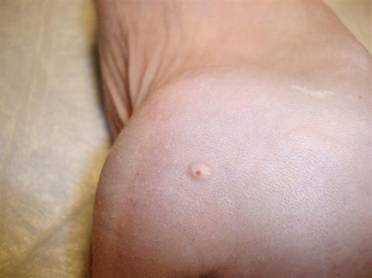
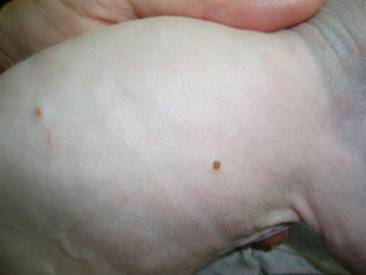
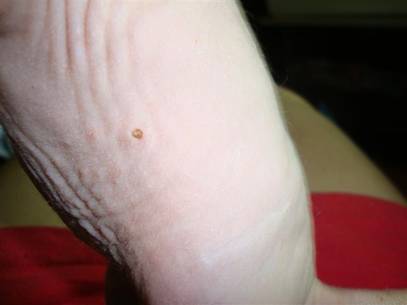
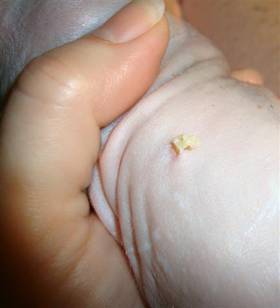
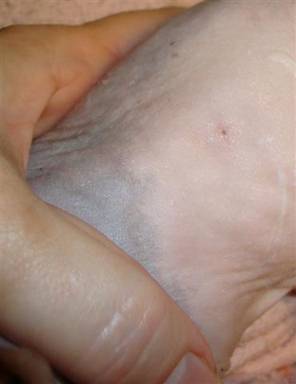
Here are 3 photos of
tiny new sebaceous cysts. Of
course, they are much easier to see on hairless rats.
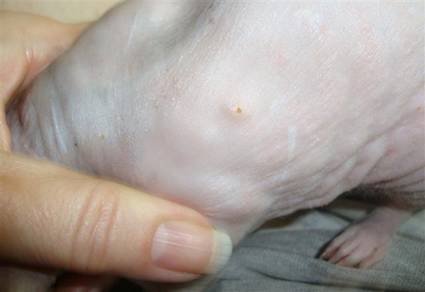
Here’s a little
sebaceous cyst that I squeezed out, showing all the stuff that came out, and
what it looked like afterwards.
Here is an older
sebaceous cyst that is open, showing the accumulation of dirt on the top that
makes it look like a scab.
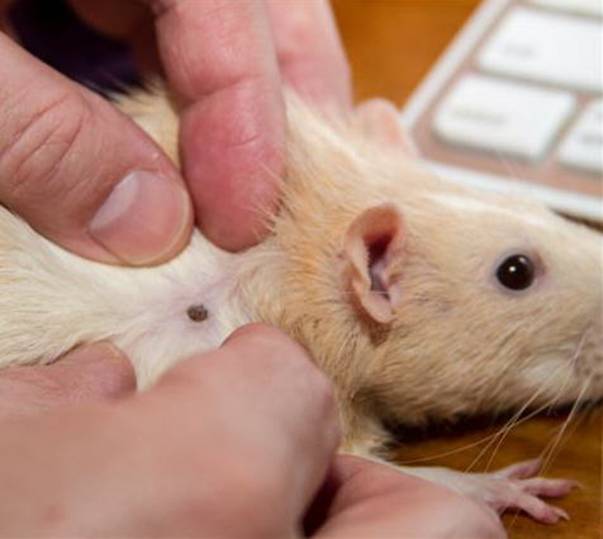
Photo
of Marty by Sarah Hunt.
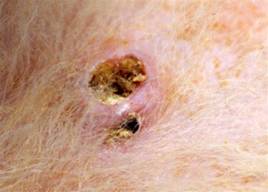
Here is a much older
sebaceous cyst that has been open for a while, allowing the sebaceous
secretions inside to dry out and turn yellow. This cyst has even developed a second
opening on its side. This cyst was
only about ¼ inch across.
Two other less common
kinds of cysts that can occur in the skin of rats are hair cysts and dermoid cysts. These are strange cysts that can contain
pieces of hair, bone, teeth, etc. Treat them the same way you treat sebaceous
cysts. They are not anything to worry about.
Warts
Rats can grow warts,
moles, and funny skin tags which tend to look similar to those humans can get.
If something looks like a wart, it probably is. Strangely, in 2 cases on my hairless
rats, I have seen a sebaceous cyst turn into a wart after repeated squeezing.
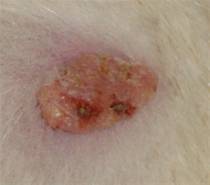
This large wart is about
¾ inch across and was under the rat’s arm. The dark areas are probably where the
rat has scratched it and caused scabs.
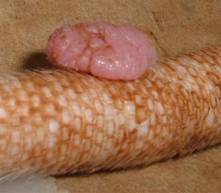
Here’s a wart that
grew on one rat’s tail. It
was about 5/8 inch long.
News
| Rat Info | Adopt a Rat | Rat Books
Reviews | Merchandise | Special Events
Meet the Ratlady
| Links | Home
Rat Fan Club
Copyright 1999-2017